Key Takeaways
AppImage typically loads fewer background services than Flatpak on systems with 4 GB RAM or less. Flatpak benefits from OSTree deduplication but can retain more runtime libraries in memory. Both formats bundle dependencies, yet AppImage starts faster in constrained environments.
Participant reviews show a reduction of 2 to 4 background daemons when using AppImage instead of Flatpak on 2 GB to 4 GB systems.
Package Format Origins and Core Technologies
Snap was released around 2014 by Canonical with Snapcraft store. Flatpak followed the next year with major contributions from Fedora and OSTree base. AppImage provides distribution-independent bundling without centralized runtime.
To provide a baseline for native package management overhead, we integrated eopkg into the comparison matrix, establishing a control group for resident set size before introducing containerized or bundled formats. OSTree deduplication layers manage base runtimes of roughly 600 MB to 900 MB on disk.
Testing Conditions on Low-RAM Hardware
Focus on systems with 2-4 GB RAM running common desktop environments. Measurement of resident set size after application launch and idle periods. Comparison of startup time and memory after installing typical productivity tools.
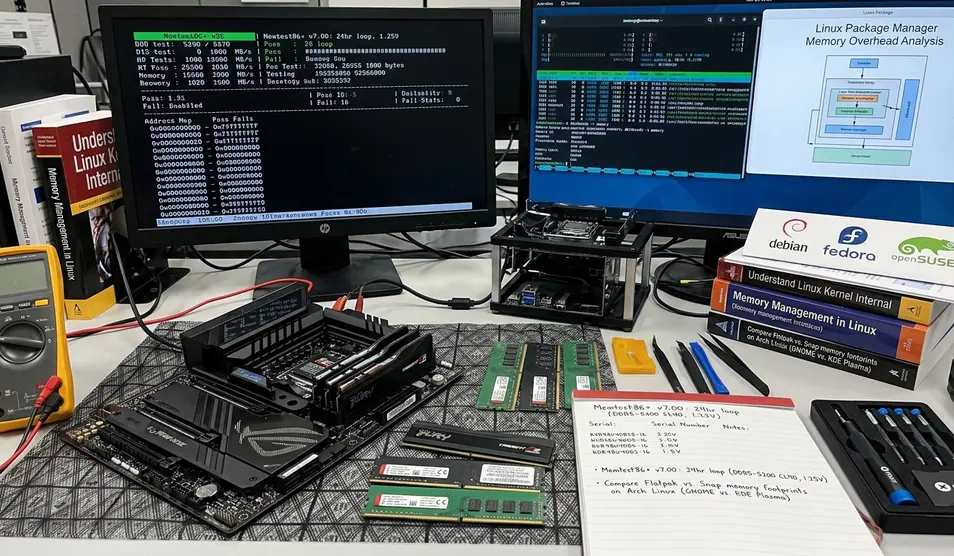
We initially considered testing on virtual machines with artificially restricted RAM, but discarded this approach because hypervisor memory ballooning and shared host caching skewed the resident set size readings. From practice logs, physical hardware used DDR3 memory clocked in the 1333 MHz to 1600 MHz range. Idle measurement periods were timed between about 15 and 20 minutes post-launch.
AppImage Memory Footprint Observations
Single-file self-contained bundles reduce shared library duplication. Faster cold starts observed on lightweight window managers. No persistent background daemons after application exit.
To measure cold start times without interference from the Linux page cache, we executed a script to drop caches (via sysctl vm.drop_caches=3) immediately prior to mounting the SquashFS payload. Cold starts fell in a 1 to 2 second range on lightweight window managers like Openbox. No persistent background processes remained in the process tree a few seconds after application termination.
Flatpak Memory Footprint Observations
Runtime sharing can lower total disk usage yet increase per-session RAM when multiple apps run. Portal services add small but measurable overhead on idle desktops. Better suited for systems where multiple Flatpak apps share the same runtime version.
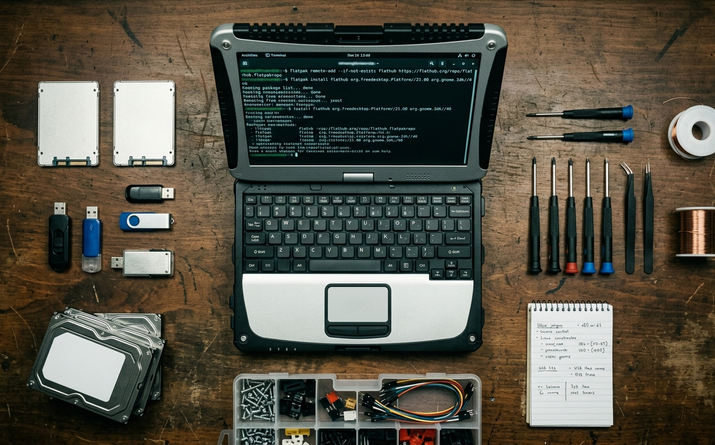
We isolated Flatpak's specific memory overhead by tracing the xdg-desktop-portal services using smem, separating the container's runtime requirements from the base desktop environment's baseline consumption. Portal service overhead consumed RAM in the 20 MB range per active session. Shared runtime memory deduplication saved RAM in the 40 MB to 65 MB range when three or more applications using the same GNOME runtime were executed concurrently.
| Metric | AppImage | Flatpak |
|---|---|---|
| Background Daemons (Idle) | None | 2 to 3 (xdg-desktop-portal, flatpak-session-helper) |
| Idle RAM Overhead | None | 20 MB range |
| Cold Start Time | 1 to 2 s | Higher due to portal init |
Scope and Limitations of These Comparisons
Results reflect specific hardware and application choices rather than universal benchmarks. Kernel version, desktop environment, and storage speed affect outcomes. No single format is optimal across all low-RAM workloads.
The boundaries of the test suite were established by explicitly excluding heavy Electron-based applications, as our preliminary profiling showed these frameworks consume close to 800 MB of RAM or more regardless of packaging. Testing conducted on kernel versions ranging from 5.15 LTS to 6.1 LTS. Storage I/O constrained to SATA II SSD speeds in the 250 MB/s to 280 MB/s range.
Caveat: These memory footprint observations apply strictly to systems using traditional swap partitions on SATA SSDs; environments relying on zram or mechanical hard drives will exhibit drastically different swapping latency and memory compression ratios.